
Advertising on Flipkart is essential for brands striving to boost product visibility and capture high-intent shoppers. With millions of daily active users, mastering Flipkart Ads—specifically Product Listing Ads (PLA) and Product Contextual Ads (PCA)—can mean the difference between a high-performing campaign and wasted ad budget.
While both ad formats drive traffic to your product pages, they serve different stages of the buyer journey. Understanding how to align PLA and PCA with your target customer intent optimizes ad spending and maximizes Return on Ad Spend (ROAS).
1. What Are Flipkart Product Listing Ads (PLA)?
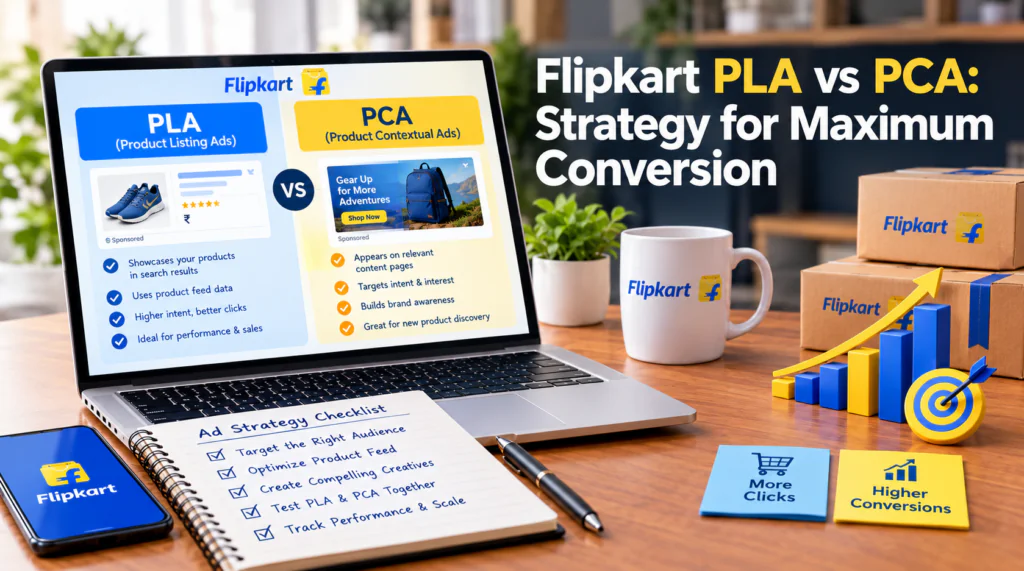
Flipkart Product Listing Ads (PLA) are intent-driven search ads. They appear directly on Search Results Pages (SERP) and Category Pages when a customer actively types a search query or browses a specific category.
[Customer Searches: "Bluetooth Headphones"] ──► [PLA Appears at Top of SERP] ──► [Direct Click & Purchase]
- Targeting Mechanism: Keyword-based and category-based targeting.
- Placement: Top slots of search results pages, category browsing pages, and filter pages.
- User Intent: High purchase intent. The customer is actively looking for a product to buy immediately.
- Bidding Model: Cost-Per-Click (CPC). You pay only when a user clicks on your ad.
PLA is the foundation of Flipkart advertising because it targets bottom-of-the-funnel buyers who are already at the point of conversion.
2. What Are Flipkart Product Contextual Ads (PCA)?
Flipkart Product Contextual Ads (PCA) focus on contextual relevance and cross-selling. Rather than relying solely on explicit search keywords, PCA displays your products on Product Detail Pages (PDPs) of similar or complementary items.
[Customer Views: Competitor Phone Case] ──► [PCA Banner/Widget on PDP] ──► [Cross-Sell / Impulse Purchase]
- Targeting Mechanism: Product-to-product mapping, user browsing behavior, and complementary category association.
- Placement: Competitor product pages (“Similar Products”, “Customers Who Bought This Also Bought”), cart pages, and checkout recommendation widgets.
- User Intent: Consideration and mid-funnel evaluation. The buyer is researching a specific product or evaluating alternatives.
- Bidding Model: Cost-Per-Click (CPC) or Cost-Per-Thousand-Impressions (CPM).
PCA allows brands to intercept competitor traffic and pitch value bundles or better alternatives right before the final checkout decision.
3. Flipkart PLA vs PCA: Core Comparison
| Feature | Product Listing Ads (PLA) | Product Contextual Ads (PCA) |
| Primary Goal | High-intent conversion & rank push | Consideration, cross-selling & competitor poaching |
| Placement Area | Search results (SERP) & Category pages | Product detail pages (PDP) & Cart pages |
| Targeting Mode | Search queries & Keywords | Product affinity & Behavioral context |
| Typical CTR | High (1.5% – 3.5%) | Moderate (0.5% – 1.5%) |
| Conversion Rate | High | Moderate to High (Category dependent) |
| Best Used For | Core product catalog & best-sellers | New product launches & complementary SKUs |
4. Strategic Framework for Maximum Conversion
To maximize conversions on Flipkart, avoid running PLA or PCA in isolation. Instead, combine both formats into a full-funnel strategy:
                  [Top / Mid Funnel: PCA]
  Target Competitor PDPs & Cross-Sell Categories
                            │
                            ▼
                [Bottom Funnel: PLA]
  Dominate High-Intent Search Queries & Top SERP
A. Defensive & Offensive Keyword Targeting with PLA
- Defensive Strategy: Bid heavily on your own brand keywords (e.g., “YourBrand Shoes”) to prevent competitors from stealing high-intent traffic at the top of the search page.
- Offensive Strategy: Target broad category keywords (e.g., “running shoes under 2000”) to capture non-brand search volume and drive immediate sales velocity.
B. Competitor Interception with PCA
- Identify top 10 best-selling competitor ASINs/FSNs in your niche.
- Deploy PCA campaigns targeting their detail pages. Offer a clear value proposition—such as a better price point, extra features, or superior ratings—to encourage buyers to switch.
- Cross-sell accessories: If you sell smartphone cases, target the detail pages of popular smartphone models using PCA.
C. Budget Allocation Rule (70/30 Split)
- 70% Budget to PLA: Direct the majority of your daily budget to PLA to secure high-intent search traffic and maintain baseline sales volume.
- 30% Budget to PCA: Allocate the remaining budget to PCA for targeted cross-selling, audience expansion, and competitor page placements.
If you are expanding your advertising efforts across other major marketplaces and struggling with campaign efficiency, read our detailed framework on How to Fix Low ROAS on Amazon Sponsored Products: Step-by-Step Optimization Guide.
5. Aligning On-Page Conversion Elements
Driving clicks via PLA or PCA will not produce results if your product listing lacks conversion triggers. Optimize these key elements before scaling ad spend:
- Competitive Pricing & Flipkart Smart Fulfillment: Ensure your pricing remains competitive and listings carry the Flipkart Assured badge to maximize conversion efficiency.
- High-Quality Image Stack: Feature clear product angles, infographics, and usage callouts in the first 3 gallery slots.
- Rating & Review Threshold: Avoid scaling ads on SKUs with fewer than 10 ratings or overall scores below 3.8 stars.
- In-Stock Availability: Stockouts penalize your organic search rank and disrupt automated bidding algorithms.
For sellers managing multi-channel operations across quick commerce and marketplaces, explore our complete onboarding guide on Zepto Seller Onboarding Guide 2026: Requirements, Margins, and Dark Store Allocation to optimize your supply chain.
If you are preparing your ad campaigns and inventory for India’s peak shopping events, follow our step-by-step Festive Season E-commerce Checklist: How to Prepare Inventory and Ads for Big Billion Days & Great Indian Festival.
Frequently Asked Questions (FAQs)
Q1: Which is better for a new product launch on Flipkart: PLA or PCA?
PLA is generally better for initial product launches because it targets users actively searching for exact category terms. However, running low-bid PCA alongside PLA helps gain early visibility on established competitor listings.
Q2: How does Flipkart PLA impact organic product rankings?
Sales velocity generated through PLA positively influences Flipkart’s organic ranking algorithm. Higher conversion rates and order volume signals product relevance, helping improve organic positions over time.
Q3: Can I run PLA and PCA simultaneously for the same SKU?
Yes. Running both formats simultaneously ensures complete coverage across search pages (PLA) and competitor product pages (PCA), maximizing brand exposure across the platform.
Q4: How often should I optimize bids on Flipkart ad campaigns?
Review campaign performance every 3 to 5 days. Avoid making daily bid changes, as automated ad systems require attribution windows to stabilize performance data.