

The quick commerce revolution in India has transformed consumer buying behavior, moving from same-day delivery to 10-minute fulfillment. Dominating this hyper-growth channel requires a structured approach.
For brands seeking scale, learning how to sell on Zepto is no longer optional—it is a core strategy to access high-intent urban shoppers with high repeat purchase rates.
Eligibility Criteria & Mandatory Documentation
Unlike open-marketplace platforms like Amazon or Flipkart, Zepto operates a curated B2B vendor network. To pass initial category manager evaluations, your business must meet strict compliance standards:
1. Business Registration & Tax Identification
- GST Registration: A valid, active GSTIN matching your legal entity.
- APOB (Additional Place of Business): Critical for multi-city inventory placement. You must register Zepto’s regional mother hubs/warehouses under your GST as an additional place of business.
- PAN & Entity Proof: Business PAN card alongside Certificate of Incorporation, LLP Agreement, or Proprietorship proof.
2. Regulatory & Category-Specific Licenses
- FSSAI License: Mandatory for all food, beverage, dairy, and consumable categories. The license must explicitly cover your operational scale and category types.
- Trademark Certificate: Required to establish brand ownership or formal distribution authorization from the brand owner.
- Barcode Identification: Every SKU must feature individual GTIN/EAN barcodes for rapid scanning at dark store receiving hubs.
If you are expanding beyond quick commerce to broader marketplace channels, review our detailed walkthrough on How to Scale E-commerce Sales to 10 Lakhs Per Month to optimize your multi-channel supply chain.
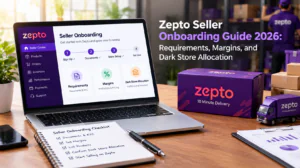
Step-by-Step Zepto Onboarding Process
- Submission via Brand Partner Portal: Submit your application through the official Zepto Brand Partner Portal with your catalogue summary and target geographies.
- Category Manager Evaluation: A designated Category Manager evaluates your submission based on demand gaps, pricing feasibility, and packaging durability.
- Commercial Terms & Agreement Signing: Negotiate margins, credit cycles, and payment terms, specifying operational SLAs and return policies.
- Listing & Catalogue Integration: Upload high-resolution images, EAN codes, ingredient declarations, and shelf-life metrics.
Understanding Margin Structures & Costs
| Product Category | Typical Commission Range | Payment Settlement Cycle | Key Growth Levers |
| Grocery & Food Staples | 12% – 16% | 30 to 45 Days | High purchase frequency, bundle deals |
| Packaged Snacks & Beverages | 15% – 22% | 30 to 45 Days | In-app visibility, impulse buys |
| Personal Care & Beauty | 20% – 28% | 30 to 45 Days | Sponsored search ads, A+ content |
| Electronics & Accessories | 10% – 15% | 15 to 30 Days | Festivities, lightning deals |
Beyond base commissions, account for secondary costs such as In-App Advertising (bidding for top-of-grid visibility), Promotional Discounting (co-funded banner campaigns), and Logistics to regional mother hubs.
Dark Store Allocation & Inventory Strategy
Dark stores are micro-warehouses (2,000 to 4,000 sq. ft.) situated inside dense urban clusters, designed for 2-minute order picking.
- Initial Supply to Mother Hubs: Goods are sent to Zepto’s central fulfillment center rather than individual dark stores.
- Algorithmic Allocation: Zepto routes inventory from the Mother Hub to neighborhood dark stores using hyper-local demand forecasting.
- Maintaining High In-Stock Rates: Stockouts negatively impact app search rankings. Ensure continuous inventory flow to avoid visibility penalties.
Frequently Asked Questions (FAQs)
Q1: What is the average onboarding timeline for new brands on Zepto?
The onboarding timeline generally spans 15 to 30 business days, depending on document completeness, APOB registration speed, and category manager bandwidth.
Q2: Is FSSAI mandatory for selling non-food items on Zepto?
No. FSSAI is strictly mandatory for food, beverage, grocery, and dietary supplement categories. Non-food products require standard business registrations and GST.
Q3: Can individual sellers register on Zepto without a registered business?
No. Zepto does not accept individual or unregistered sellers. You must operate as a legally registered business entity (Proprietorship, Partnership, LLP, or Private Limited) with an active GSTIN.
Q4: How does dark store allocation work for a new product launch?
Zepto initially places test inventory across high-performing pilot dark stores within key target metros. Based on sales velocity and re-order rates, the algorithm expands distribution across wider dark store networks.