
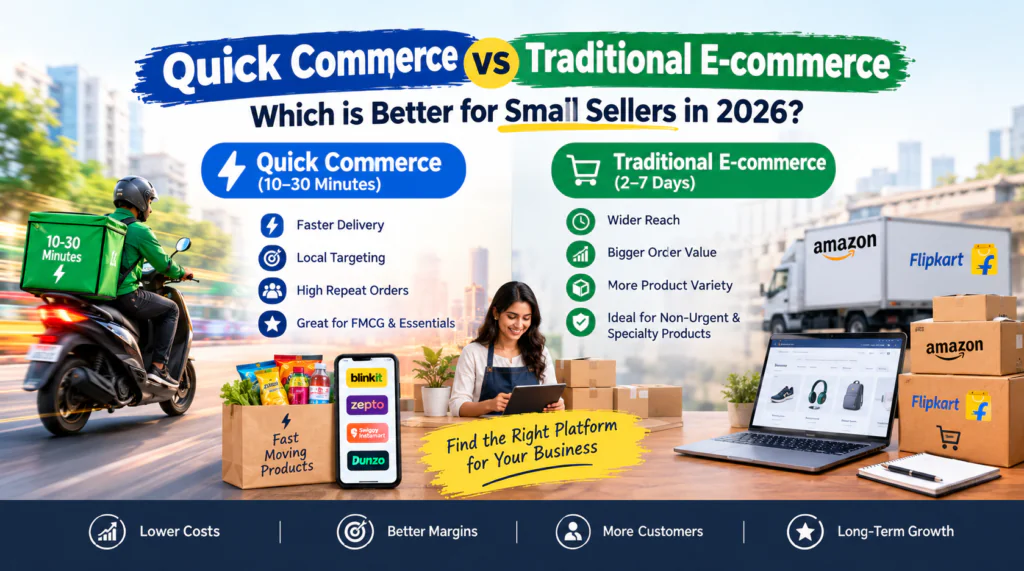
The Indian online retail ecosystem has undergone a massive transformation. The rise of Quick Commerce (Q-Commerce) platforms like Blinkit, Zepto, and Swiggy Instamart has changed consumer behavior, promising delivery in under 10 to 15 minutes.
On the other side stands Traditional E-commerce (E-Commerce) led by giants like Amazon, Flipkart, and Meesho, which focus on wider catalog selections and 1-to-3-day nationwide deliveries.
For small-to-medium sellers, FMCG manufacturers, D2C brands, and local business owners in India, this rapid evolution brings a critical question: Should you sell on Quick Commerce platforms or stick to Traditional E-commerce marketplaces in 2026?
In this detailed comparison guide, we analyze both business models across onboarding criteria, commission rates, dark store inventory requirements, profit margins, and return ratios to help you choose the best channel for your products.
Quick Answer
Which is better for small sellers: Quick Commerce or Traditional E-commerce?
Quick Commerce is best for high-frequency, impulse-buy, FMCG, packaged food, and daily essentials brands targeting metro and Tier-1 urban buyers who need ultra-fast turnover.
Traditional E-commerce is better for apparel, electronics, long-tail goods, unbranded items, and high-ticket products targeting a nationwide customer base across Tier-1, Tier-2, and Tier-3 cities with lower inventory holding barriers.
1. Key Differences at a Glance
| Feature | Quick Commerce (Q-Commerce) | Traditional E-commerce |
| Major Platforms | Blinkit, Zepto, Swiggy Instamart | Amazon, Flipkart, Meesho, Myntra |
| Delivery Time | 10 to 30 minutes | Same day to 3–5 days |
| Fulfillment Model | Hyperlocal Dark Store Hubs | Central Warehouses (FBA/FBF) or Merchant Direct |
| Ideal Product Categories | FMCG, Groceries, Beverages, Personal Care, Daily Essentials | Fashion, Electronics, Home Decor, Niche/Long-tail Items |
| Customer Target | Metro & Tier-1 Urban Shoppers | Pan-India (Tier-1, 2, 3, 4) |
| Return Rates | Extremely Low (Under 2–3%) | Moderate to High (10–30%) |
| Inventory Barrier | High (Requires upfront local dark store stock) | Low to Medium (Sell-as-you-go or consignment) |
2. How Quick Commerce Works for Sellers
Quick Commerce operates through a localized network of Dark Stores (micro-fulfillment centers) situated within a 2-to-3-kilometer radius of densely populated urban areas.
Seller Supplies Stock -> Local Dark Store Hubs -> App Listing Live -> Customer Orders -> Delivery in 10 Mins
Advantages of Quick Commerce:
- Unmatched Repeat Purchase Rates: Consumers reorder groceries, personal care, and snacks weekly or even daily, giving brands continuous sales velocity.
- Near-Zero Customer Returns (RTO): Because orders are delivered instantly, buyer cancellation and refusal rates are practically negligible compared to traditional e-commerce.
- High Impulse Visibility: Prominent placement on apps like Zepto or Blinkit drives fast brand discovery for impulse purchases. To explore how this ecosystem operates, read our overview on Quick Commerce solutions in India.
Challenges of Quick Commerce:
- Inventory Fragmentation: You must distribute inventory across dozens or hundreds of individual dark stores rather than shipping to one central warehouse.
- Strict Expiry & Damage Norms: FMCG items with short shelf lives carry higher risk if off-take rates drop.
- Margin Pressures: High platform operational costs mean seller margins require tight management. Learn more about platform cost breakdowns in our complete guide to Blinkit, Zepto, and Instamart seller commissions.
3. How Traditional E-commerce Works for Sellers
Traditional e-commerce platforms like Amazon, Flipkart, and Meesho rely on regional fulfillment centers or seller-managed pick-and-pack services (Easy Ship / Self-Ship).
Advantages of Traditional E-commerce:
- Pan-India Reach: Access hundreds of millions of shoppers across Tier-1, Tier-2, Tier-3, and rural pin codes without needing localized stock placement.
- Lower Upfront Capital: You can list your full product catalog without pre-committing bulk inventory to specific micro-hubs.
- Unlimited SKUs: Ideal for long-tail items, specialized variations, and low-velocity products that do not fit the high-turnover demand of quick commerce.
Challenges of Traditional E-commerce:
- High Return Rates (RTO/DTO): Return rates in categories like apparel or footwear can range from 15% to 35%, eating into net profit margins.
- High Competition & PPC Costs: Ranking on Page 1 of Amazon or Flipkart requires active ad spending (Sponsored Products) and continuous SEO optimization.
4. Profitability & Cost Comparison: Where Do You Make More Money?
1. Commission & Listing Fees
- Quick Commerce: Generally works on a margin-discount or wholesale-purchase model where platforms negotiate a bulk brand discount (ranging from 15% to 35% depending on category and volume).
- Traditional E-commerce: Operates on a pay-per-sale model consisting of Referral Fees, Closing Fees, Fixed Fees, and Weight-handling Shipping charges.
2. Logistics & Returns Impact
While Quick Commerce may require higher margin cuts upfront, it saves money on return logistics costs. In Traditional E-commerce, failed deliveries (RTOs) and customer returns incur reverse shipping fees, damaged product write-offs, and packaging losses.
Net Profit = Selling Price - (Product Cost + Platform Fees + Logistics + Return Losses)
5. Which Platform Strategy Should You Choose in 2026?
Choose Quick Commerce If:
- You manufacture or sell packaged food, beverages, personal care, beauty products, pet supplies, or home daily essentials.
- Your target audience primarily resides in metro and Tier-1 urban hubs.
- You have the supply chain capability to maintain stock levels across localized dark store networks. If you are ready to expand onto quick commerce platforms, step-by-step guidance is available in our detailed Zepto seller onboarding guide.
Choose Traditional E-commerce If:
- You sell fashion, electronics, appliances, furniture, or niche unbranded goods.
- You want to reach buyers across Tier-2, Tier-3, and rural regions in India.
- You are starting with a small initial inventory and want to scale nationwide without heavy dark store distribution capital.
Frequently Asked Questions
Q1. Can small regional brands get listed on Blinkit, Zepto, or Swiggy Instamart?
Yes, quick commerce platforms actively onboard regional and emerging D2C brands, provided the products meet local compliance standards, possess required certifications (such as FSSAI for food items), and demonstrate stable local supply capacity.
Q2. Is return handling higher on Quick Commerce or Traditional E-commerce?
Return handling costs are significantly higher on Traditional E-commerce due to buyer change-of-mind returns, sizing issues, and courier non-deliveries. Quick Commerce experiences near-zero return rates due to immediate fulfillment.
Q3. Can a business sell on both Quick Commerce and Amazon/Flipkart simultaneously?
Yes, an omnichannel approach—using Amazon/Flipkart for pan-India catalog reach and Quick Commerce hubs for high-velocity urban sales—is the standard growth strategy for top D2C brands in India.
Final Verdict
Quick Commerce and Traditional E-commerce are not mutually exclusive; they serve different consumer mindsets. Quick Commerce satisfies instant urgency, while Traditional E-commerce satisfies breadth of choice and deep comparison.
For small FMCG and daily essentials sellers in 2026, entering Quick Commerce provides unmatched sales velocity and lower return losses. For long-tail, apparel, and non-essential sellers, Traditional E-commerce remains the backbone of pan-India expansion.
Looking to onboard your brand onto Quick Commerce or optimize your e-commerce store for maximum sales growth? Contact QBIT ECOMMERCE today for expert listing, onboarding, and marketplace management services.