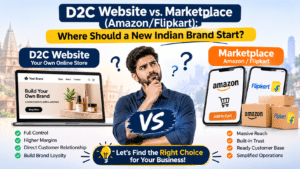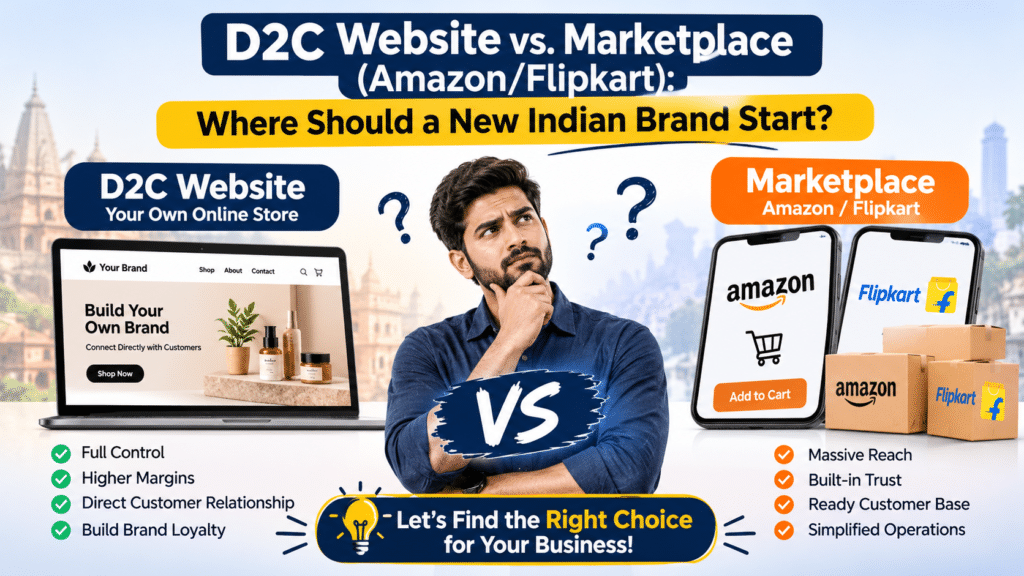
When launching a new e-commerce brand in India, founders almost always face the ultimate strategic crossroads: Should we build our own D2C Shopify website, or should we list on established marketplaces like Amazon, Flipkart, and Meesho?
It is one of the most consequential decisions you will make. Marketplaces offer instant traffic and millions of ready-to-buy shoppers, but they take a massive slice of your margins and leave you with zero customer data. On the other hand, a standalone D2C website gives you complete control over your brand identity and customer relationships, but demands heavy performance marketing budgets just to get your first visitor.
To make the right choice, let’s weigh the pros and cons of both paths and explore a proven hybrid phased roadmap tailored for Indian startup brands.
Marketplaces (Amazon, Flipkart, Meesho): Pros & Cons
The Pros:
- Instant High-Intent Traffic: Millions of active Indian shoppers visit Amazon and Flipkart every single day with their credit cards and UPI apps ready. You don’t need to spend lakhs on branding before getting your first order.
- Built-In Trust & Logistics: Cash on Delivery (COD), trusted returns, and robust last-mile delivery networks (like Amazon FBA, Flipkart FBF, and Delhivery) are handled right out of the box.
- Fast Cash Flow Generation: Because buyers already trust the platform, conversion rates for well-optimized listings can jump quickly, helping you validate product-market fit.
The Cons:
- High Platform Commissions & Fees: Marketplace commissions, closing fees, referral fees, GST, and mandatory ad spends routinely eat up 30% to 45% of your top-line revenue.
- Zero Customer Ownership: You don’t own your customer data. You cannot email them, retarget them directly for repeat purchases, or build a loyal community because the marketplace owns the buyer relationship.
- Brutal Price Wars: Competitors can easily undercut your pricing on the same search results page, turning your brand into an interchangeable commodity.
For a deeper dive into how marketplace dynamics compare against independent storefronts, read our detailed analysis on e-commerce marketplaces vs. your own website.
D2C Shopify Storefronts: Pros & Cons
The Pros:
- Total Brand & Margin Control: Every rupee of profit stays in your pocket (minus basic payment gateway fees and Shopify subscriptions). You set the pricing, discounts, and design aesthetics.
- 100% Customer Data Ownership: You capture customer phone numbers, email addresses, and purchase histories, enabling high-ROI retention marketing via WhatsApp (WATI/Interakt) and Klaviyo email flows.
- No Direct Competitor Distractions: When a shopper lands on your Shopify store, they are immersed entirely in your brand story—no banner ads for competing products or sponsored rival listings in the footer.
The Cons:
- High Customer Acquisition Cost (CAC): Nobody visits a new website by accident. You must spend heavily on Meta (Instagram/Facebook) and Google Ads to drive every single click, which can burn through capital fast.
- Logistics & Trust Friction: Unlike Amazon Prime, a brand-new unknown D2C website has to build trust from scratch. Managing COD verification, RTO risks, and third-party shipping integrations requires active operational effort.
To understand why modern Indian consumer brands ultimately transition into independent storefronts, check out our guide on building scalable D2C brands with your own e-commerce website.
The Winning Hybrid Roadmap for Indian Startups
Instead of choosing one extreme over the other, successful Indian D2C founders increasingly adopt a Phased Hybrid Rollout Strategy that leverages marketplace cash flow to fund independent brand growth.
Phase 1: Marketplaces (Months 0–6) ──> Phase 2: Hybrid Expansion (Months 6–12) ──> Phase 3: D2C Flagship (Year 2+)
[Build cash flow & validate SKUs]   [Launch Shopify + insert unboxing inserts]    [Drive performance ads & loyalty]
Phase 1: Marketplace Validation (Months 0 – 6)
- Goal: Validate your product-market fit, refine your packaging, and generate steady cash flow with minimal upfront ad burn.
- Execution: Launch 3 to 5 hero SKUs on Amazon and Flipkart. Focus heavily on winning reviews, optimizing your main images, and keeping your return rates low.
- The Secret Weapon: Slip a branded discount card or QR code (“Get 15% off your next order on our official website“) inside every marketplace shipping box. This legally converts marketplace buyers into your owned D2C audience.
Phase 2: The Shopify Launch (Months 6 – 12)
- Goal: Establish your independent brand home and begin capturing customer data.
- Execution: Build a clean, lightning-fast Shopify store. Set up automated WhatsApp order confirmation and abandoned cart recovery flows. Run targeted Meta ad campaigns driving traffic to exclusive Shopify-only bundles (combos that aren’t available on Amazon).
- For strategic insights on aligning your marketplace metrics with an independent Shopify rollout, read our comprehensive marketplace vs. D2C Shopify store strategy guide for India.
Phase 3: Scale & Retention (Year 2 Onwards)
- Goal: Shift revenue distribution toward your D2C website while using marketplaces as stable top-of-funnel discovery channels.
- Execution: Reinvest your D2C profit margins into influencer marketing, performance branding, and community building, transforming a transactional product into a memorable lifestyle brand.
Frequently Asked Questions (FAQs)
1. Can a brand survive in India using only a Shopify D2C website without marketplaces?
Yes, but it requires significantly higher initial capital (typically ₹5L to ₹20L+ in performance marketing reserves) and a product with strong visual appeal, high repeat purchase potential, or unique differentiation that drives viral social media growth.
2. Is it allowed to put website flyers or discount inserts inside Amazon/Flipkart packages?
Marketplaces strictly prohibit placing promotional inserts that explicitly direct buyers away from their platform to buy the same item cheaper elsewhere. However, providing customer support contact info, warranty registration QR codes, or brand community links within acceptable policy bounds is common practice among top sellers.
3. Which platform is better for building a high-end luxury or artisanal brand in India?
A Shopify D2C website is far superior for luxury, artisanal, or niche aesthetic brands. Marketplaces are heavily price-sensitive, whereas your own website allows you to curate unboxing experiences, storytelling, and premium pricing without being compared side-by-side with cheap knockoffs.
4. How much does it cost to set up a Shopify store in India versus selling on Amazon?
Setting up a basic Shopify store costs around ₹1,500 to ₹5,000 per month in software and app subscriptions, plus your digital marketing budget. Selling on Amazon has lower upfront entry costs (with professional plans costing ₹1,499/month plus referral fees), but platform commissions and ad CPCs scale directly with your sales volume.