Quick commerce has permanently reshaped how urban India shops. Across metros and Tier-1 cities, consumers no longer wait two to three days for routine household essentials, snacks, beverages, or personal care products—they expect doorstep delivery in under 15 to 20 minutes.
For FMCG and D2C brands, getting listed on Blinkit, Zepto, or Swiggy Instamart unlocks massive daily order velocity and near-zero RTO (Return to Origin) losses. However, quick commerce operates on hyper-local dark store economics that differ drastically from traditional marketplaces like Amazon and Flipkart. Pitching all three platforms simultaneously without understanding their margin demands, Minimum Order Quantities (MOQs), and buyer demographics can quickly drain your working capital.
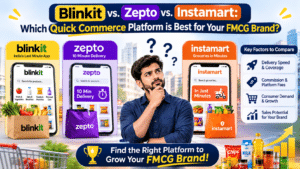
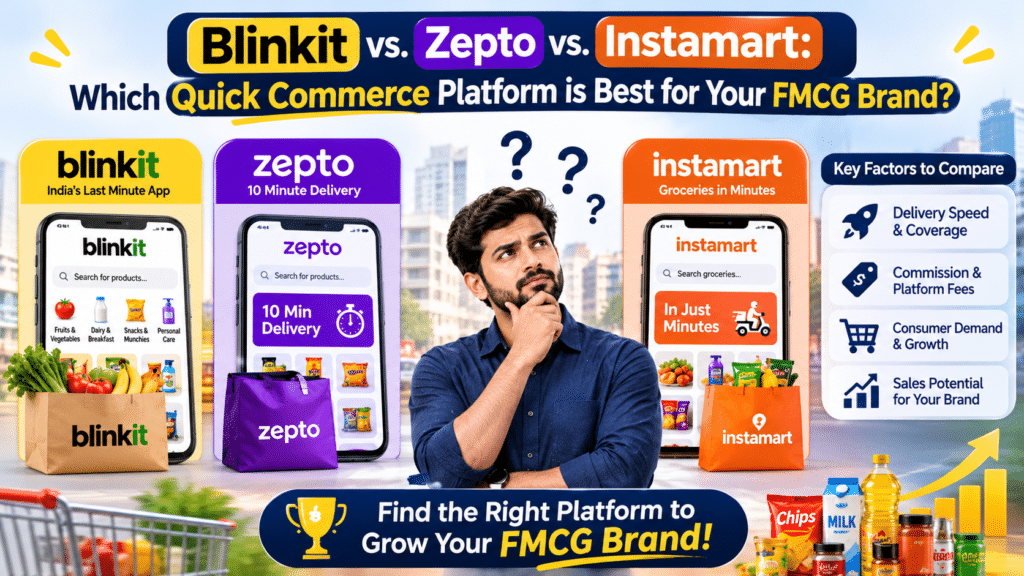
Here is a strategic, side-by-side comparison of Blinkit, Zepto, and Swiggy Instamart to help you decide where to launch your FMCG brand first.
Blinkit vs. Zepto vs. Swiggy Instamart: At a Glance
While exact commercial terms depend on your product category, brand traction, and negotiation leverage, industry benchmarks reveal clear structural differences across the big three platforms:
| Parameter | Blinkit (Eternal / Zomato) | Zepto | Swiggy Instamart |
| Market Share & Reach | Market leader (~46% GMV share) across 30+ cities with 2,000+ dark stores. | ~29% GMV share; heavily concentrated in top metros (15+ cities, 900+ dark stores). | ~22% GMV share across 32+ cities with 700+ dark stores. |
| Base Commission / Margin | 15% – 25% (plus fixed/fulfillment fees depending on Seller Hub vs. PO model). | 16% – 25% (often negotiates higher upfront gross margins for rapid restocking). | 15% – 24% (generally offers the lowest entry margin band for staples/FMCG). |
| Dark Store Slotting & Listing Fees | Flexible; self-serve Seller Hub allows entry without heavy upfront slotting, though paid visibility is expected. | Selective curation; often expects launch ad commitments or slotting support for prime dark store shelf space. | Category-team driven; may require an initial launch package (ad credits + city rollout fees) for new brands. |
| Initial MOQ & Inventory | Pilot batches often start with 1–2 mother hubs (50–100 units per SKU) before wider dark store expansion. | Tighter SKU curation; requires consistent fill rates across high-throughput metro dark stores. | Typically starts with ~50 units per SKU in a pilot city (e.g., Bengaluru) before multi-city scaling. |
| Target Demographics | Mass-affluent households, families, and high-frequency grocery/staple shoppers. | Young urban professionals, Gen-Z, and impulse buyers with higher Average Order Values (AOV). | Existing Swiggy food-delivery users cross-shopping snacks, beverages, and ready-to-eat meals. |
For a deeper breakdown of how inwarding, storage, and service GST impact your net settlement across these platforms, read our complete guide on Blinkit, Zepto, and Instamart seller commissions.
Deep Dive: Which Platform Fits Your FMCG Brand Best?
1. Blinkit: Best for Mass-Market Reach & High-Velocity Staples
Backed by the largest dark store footprint in India—particularly dominant in Delhi NCR, Pune, and North Indian Tier-1/Tier-2 hubs—Blinkit is built for scale.
- Onboarding Model: Blinkit operates a self-serve Seller Hub alongside vendor Purchase Order (PO) models, making it the most accessible starting point for emerging brands with valid GST, FSSAI, and trademark documentation.
- Why Choose Blinkit: If your product is an everyday household staple, kitchen essential, dairy/snack item, or personal care SKU with proven repeat demand, Blinkit gives you the widest organic search volume.
- Watchout: Because competition on Blinkit is fierce, dark stores enforce strict inventory rotation rules. If your SKUs sit unsold in a dark store for 30 to 45 days without ad support, the system will flag them as slow-moving and trigger Return-to-Vendor (RTV) penalties.
2. Zepto: Best for Premium D2C, Gourmet Snacks & Impulse Categories
Zepto has carved out a distinct identity among younger, time-starved urban shoppers in Mumbai, Bengaluru, Hyderabad, and Delhi NCR.
- Onboarding Model: Unlike Blinkit’s open self-serve portal, Zepto uses a curated Vendor Portal where category managers evaluate your brand’s packaging, retail velocity, and differentiation before approving dark store listing.
- Why Choose Zepto: Zepto boasts high basket sizes for gourmet foods, artisanal beverages, clean-label beauty, and impulse treats. Its in-app ad engine rewards new D2C launches quickly if your packaging stands out on a mobile screen.
- Watchout: Zepto generally commands higher average Cost-Per-Click (CPC) ad rates and tighter margin expectations compared to Instamart, meaning you need at least a 50%+ gross margin cushion to stay profitable.
3. Swiggy Instamart: Best for Food Cross-Selling & South India Dominance
Swiggy Instamart leverages Swiggy’s massive food-delivery user base, giving brands a unique advantage: capturing shoppers right when they are ordering meals.
- Onboarding Model: Brands apply via the Instamart partner enquiry portal, where category teams review your catalog before granting access to the Brand Portal.
- Why Choose Instamart: Instamart is exceptionally strong in South India (especially Bengaluru, Chennai, and Hyderabad) and tends to offer slightly lower base commission bands and lower ad CPCs than Zepto. If you sell ready-to-eat meals, desserts, mixers, or beverages, food-app cross-sell campaigns perform remarkably well.
- Watchout: Approval timelines can stretch between 25 and 40 days during peak festive cycles, and category teams closely monitor city-level fill rates.
Still torn between the top two market leaders? Check out our focused head-to-head comparison of Swiggy Instamart vs. Blinkit for growing brands.
4 Golden Rules Before You Pitch Dark Store Category Teams
Dark store shelf space is strictly limited—a typical dark store holds only 3,000 to 6,000 SKUs compared to millions on Amazon. To get approved and stay stocked, follow these four rules:
- Maintain a 45% to 55% Gross Margin Cushion: Once you stack base commission (15%–25%), inwarding/storage fees, promo discounts, and mandatory in-app performance ads (8%–12% of GMV), your all-in platform take rate will sit between 30% and 38%.
- Start with Your Top 3–5 Hero SKUs: Never pitch a 50-SKU catalog on Day 1. Lead with your fastest-moving, highest-margin hero products to prove dark store velocity before unlocking broader assortments.
- Guarantee 95%+ Fill Rates & Long Shelf Life: Quick commerce platforms reject inward deliveries if food/FMCG items have less than 75% to 80% remaining shelf life. Furthermore, failing to fulfill Purchase Orders on time lowers your vendor scorecard and restricts dark store allocation.
- Sequence Your Rollout (Don’t Simulcast): Launch on one platform in one core metro first (e.g., Blinkit in Delhi NCR or Instamart in Bengaluru). Use those 60-day velocity numbers as leverage to negotiate better margins and lower slotting fees on the next platform.
Fast-Track Your Dark Store Onboarding with Qbit Ecommerce
Navigating category manager pitches, EAN/UPC barcode compliance, mother-hub PO dispatches, and in-app CPC campaigns requires specialized quick commerce expertise. Explore our dedicated quick commerce onboarding and account management services to get your FMCG brand listed faster and scaled profitably across Blinkit, Zepto, and Swiggy Instamart.
Frequently Asked Questions (FAQs)
1. What is the minimum order quantity (MOQ) required to list on Blinkit, Zepto, or Instamart?
None of the platforms publish a rigid public MOQ, as initial Purchase Orders depend on your category and launch city. However, for a single-city pilot, brands typically supply 50 to 100 units per SKU to a regional mother warehouse, which then distributes stock across 10 to 25 local dark stores.
2. Do Blinkit, Zepto, and Instamart charge dark store slotting fees?
While basic seller registration is generally free, brands launching in competitive categories are often required to commit to launch marketing packages, ad credits, or dark store visibility fees (often ranging from ₹25,000 to ₹1,00,000+ depending on city count) to secure initial shelf placement and app banner impressions.
3. What documents are mandatory for FMCG quick commerce onboarding in India?
To onboard onto Blinkit, Zepto, or Swiggy Instamart, you must have an active GSTIN (registered in the state where the mother warehouse is located), FSSAI Central or State License (mandatory for all food, beverage, and supplement products), Trademark Registration Certificate (or valid TM-A application), PAN, cancelled cheque, and GS1-registered EAN/UPC barcodes printed on every retail unit.
4. Which quick commerce platform has the lowest commission for new FMCG brands?
Swiggy Instamart typically offers the most competitive entry commission band (15% to 24%) and lower average ad CPCs, making it an attractive starting point for new FMCG brands. Blinkit follows closely for high-volume staples, while Zepto generally commands higher margins and ad spends in exchange for higher metro AOVs.