Scaling an e-commerce business across Amazon, Flipkart, Meesho, and Myntra creates exciting revenue growth—but it also creates one of the most transparent digital audit trails in the Indian tax system.
Every single rupee you sell through a marketplace is independently reported to the government by the E-Commerce Operator (ECO). Because tax authorities use automated data-matching tools to compare marketplace filings against your monthly GST returns, even a minor accounting slip-up can trigger an automated GST scrutiny or audit notice (such as ASMT-10 or DRC-01), freezing your working capital and inviting steep penalties.
To help you keep your multi-channel operations compliant, here is a clear breakdown of TCS vs. TDS compliance, the most common GST notices Indian online sellers receive, and practical steps to prevent them.
TCS vs. TDS in E-Commerce: Clearing the Confusion
Many sellers confuse TCS and TDS because both are deducted from marketplace payouts. However, they belong to two completely separate tax laws and are claimed on different government portals:
| Compliance Metric | GST TCS (Tax Collected at Source) | Income Tax TDS (Tax Deducted at Source) |
| Governing Law | Section 52 of the CGST Act, 2017 | Section 194-O (now Section 393(1) under the Income-tax Act, 2025) |
| Current Deduction Rate | 0.5% (0.25% CGST + 0.25% SGST intra-state; 0.5% IGST inter-state) | 0.1% (or 5% if PAN/Aadhaar is not furnished) |
| Calculation Base | Net value of taxable supplies (Gross taxable sales minus customer returns, excluding GST) | Gross amount of sales facilitated through the platform |
| Marketplace Filing | Reported monthly by the ECO in Form GSTR-8 by the 10th of the next month | Reported quarterly in Form 26Q |
| How Sellers Claim Credit | Accepted via the GST Portal under TDS and TCS Credit Received; credits directly to your Electronic Cash Ledger | Reflected in Form 26AS / AIS; claimed against your annual Income Tax liability |
If you are still setting up your foundational tax workflows across channels, review our complete GST e-commerce taxation guide for Amazon and Flipkart sellers to ensure your invoice structures are configured properly.
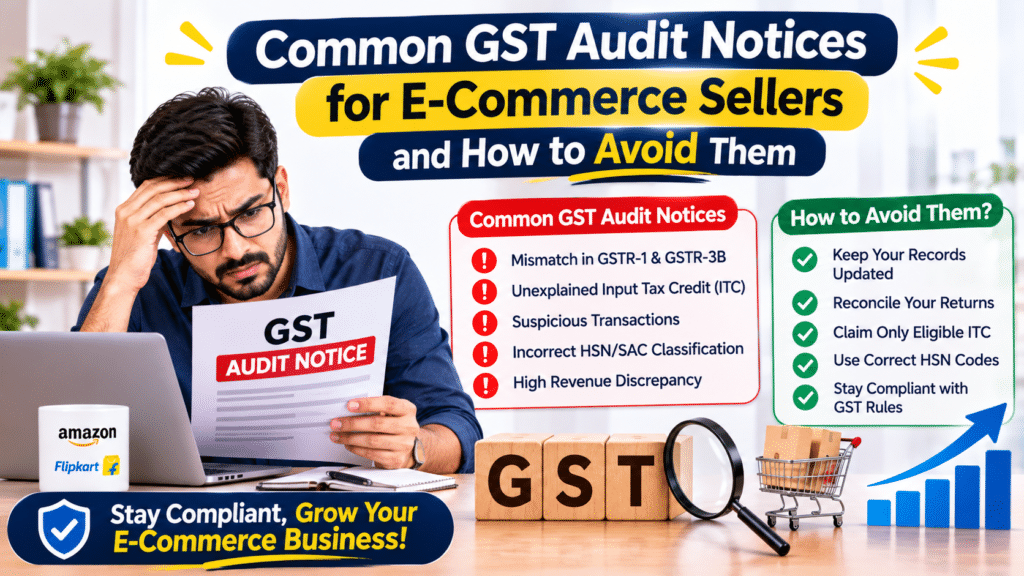
Top 5 Common GST Audit Notices for E-Commerce Sellers (and How to Avoid Them)
1. Turnover Mismatch Between GSTR-1/GSTR-3B and Marketplace GSTR-8
- Why It Happens: Marketplaces report your net taxable supplies in GSTR-8 every month. A common error occurs when sellers report net payout received in the bank (after deducting commissions, shipping, and ad fees) as their taxable turnover instead of the gross customer invoice value. When your GSTR-1 sales are lower than the figures reported in GSTR-8, the GST portal automatically flags a tax shortfall notice.
- How to Avoid It: Always file GSTR-1 using the marketplace’s Merchant Tax Report (MTR) or GST Sales Report, never your bank settlement sheet. Treat platform commissions and shipping fees separately as expense invoices to claim Input Tax Credit (ITC).
2. Unreconciled Return & Credit Note Timing Differences
- Why It Happens: A customer orders a product on March 28 (reported in March GSTR-1), rejects delivery on April 3, and the item returns to your warehouse on April 10. If you deduct that return from March’s sales without issuing a formal GST Credit Note in April, your monthly figures will clash with the marketplace’s GSTR-8 data.
- How to Avoid It: Record outward sales in the month the invoice is generated, and adjust returns strictly in the month the return credit note is issued by the marketplace.
3. Input Tax Credit (ITC) Mismatch Between GSTR-3B and GSTR-2B
- Why It Happens: Amazon, Flipkart, and Meesho raise monthly tax invoices charging 18% GST on their commissions, storage, and advertising fees. Notices frequently arise when sellers claim ITC based on rough estimates or fail to verify that the marketplace has uploaded those B2B fee invoices against the correct state GSTIN.
- How to Avoid It: Reconcile your purchase register and marketplace fee invoices against Form GSTR-2B every single month before filing GSTR-3B. Only claim ITC that appears cleanly in GSTR-2B.
4. Unregistered Multi-State Warehousing (APOB / VPOB Violations)
- Why It Happens: If you enroll in Amazon FBA or Flipkart FBF and store inventory in fulfillment centers outside your home state (for example, registering in Uttar Pradesh while storing stock in Haryana or Maharashtra warehouses), GST law requires you to obtain a separate GST registration (or Additional Place of Business) in every state where your goods are stored. Shipping from an unregistered warehouse leads to severe detention and audit penalties.
- How to Avoid It: Obtain a Principal Place of Business (PPOB) or Virtual Place of Business (VPOB) GSTIN in every state where you enable FBA/FBF fulfillment centers before dispatching stock there.
5. Wrong HSN Code or Tax Slab Classification
- Why It Happens: Applying a 5% GST slab to a product that falls under the 18% slab—or using outdated 4-digit HSN codes when your turnover requires 6-digit HSN reporting—creates immediate discrepancies during departmental scrutiny.
- How to Avoid It: Verify exact HSN codes and current GST rate notifications with a qualified Chartered Accountant before listing new SKUs, and ensure every marketplace catalog template reflects the exact tax code.
Monthly 4-Point GST Compliance Checklist for Multi-Channel Sellers
Make this 30-minute reconciliation mandatory between the 11th and 18th of every month:
- Download Marketplace Tax Reports: Export monthly B2C, B2B, and Return reports from Amazon, Flipkart, and Meesho.
- Verify GSTR-8 TCS Credits: Log into the GST portal after the 10th, verify that the TCS collected by each marketplace matches your net taxable sales at 0.5%, and accept the credit into your Electronic Cash Ledger.
- Audit Marketplace Fee Invoices: Match the 18% GST paid on marketplace commissions and ads with your GSTR-2B statement.
- Archive Audit Trail Documents: Store monthly tax reports, credit notes, e-way bills, and bank settlement statements securely for at least 6 years (72 months from the due date of furnishing the annual return) as mandated under GST record-retention rules.
Keep Your Seller Account Healthy & Compliant
Tax discrepancies and operational errors don’t just invite government notices—they can also trigger marketplace account holds if your GSTIN details fall out of compliance. Review our platform terms and conditions to understand how we safeguard seller compliance, or book our comprehensive seller account audit service to identify hidden margin leaks, tax mismatches, and account health risks before they escalate.
Frequently Asked Questions (FAQs)
1. What is the current GST TCS rate for e-commerce sellers in India?
The GST TCS rate under Section 52 is 0.5% of the net value of taxable supplies. For intra-state sales, it is split into 0.25% CGST + 0.25% SGST, while inter-state sales attract 0.5% IGST.
2. Is GST registration mandatory to sell on Amazon, Flipkart, or Meesho?
If you make inter-state supplies of goods through an e-commerce operator, regular GST registration is mandatory regardless of turnover. However, under CBIC rules, small sellers making exclusively intra-state supplies of goods through an ECO with an annual aggregate turnover below the threshold limit (₹40 lakh for goods in most states) can enroll using an Enrolment ID without a regular GSTIN, subject to marketplace onboarding rules.
3. Is TCS deducted by Amazon and Flipkart an extra tax expense for sellers?
No. TCS is not an additional tax or marketplace fee—it works like an advance tax deposit. Once the marketplace files GSTR-8 and you accept the credit on the GST portal, the 0.5% amount is credited directly to your Electronic Cash Ledger, which you can use to pay your monthly GST liability.
4. How is Income Tax TDS (Section 194-O / Section 393) different from GST TCS?
While GST TCS (0.5%) is calculated on net taxable sales and credited to your GST Cash Ledger, Income Tax TDS (0.1%) is deducted on gross sales and appears in your Income Tax Form 26AS/AIS. Individual and HUF sellers are exempt from this 0.1% TDS if their gross annual sales through the platform do not exceed ₹5 lakh and they have furnished their PAN/Aadhaar.
5. What should I do if I receive a GST ASMT-10 discrepancy notice?
Do not ignore the notice or miss the reply deadline. Download the exact figures cited by the tax officer, prepare a line-by-line reconciliation statement comparing your GSTR-1, GSTR-3B, GSTR-8, and marketplace Merchant Tax Reports (highlighting timing differences from returns or credit notes), and submit a formal explanation through the GST portal via your Chartered Accountant.