Generic reselling on Amazon India is a race to the bottom. When ten sellers list the exact same unbranded product on a single ASIN, the only way to win the Buy Box is by slashing prices—destroying your profit margins in the process.
Launching a private label brand on Amazon India changes the game completely. Instead of fighting price wars over commodity goods, you source or manufacture a high-demand product, customize it with your own branding and packaging, and own the listing exclusively. You control pricing, customer experience, and long-term brand equity.
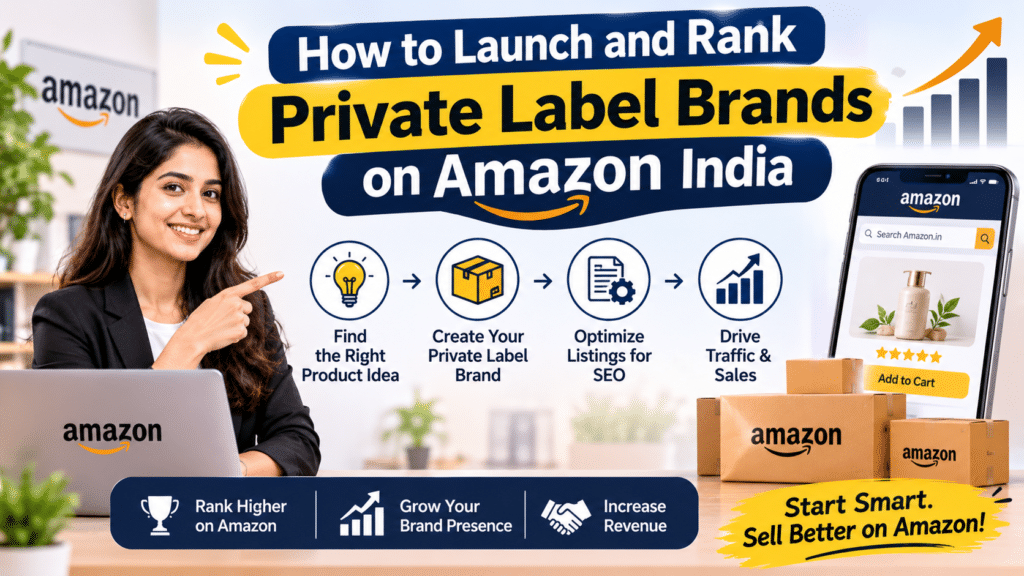
Here is a practical, step-by-step framework to build, register, and rank a profitable private label brand on Amazon.in.
Step 1: Data-Driven Product Research & Differentiation
Successful private label brands are built on proven market demand, not guesswork. Before spending a rupee on manufacturing, validate your niche using these benchmarks:
- Sweet-Spot Selling Price (₹500 – ₹2,500): Items priced below ₹400 struggle to absorb FBA shipping fees and ad costs, while items above ₹3,000 face higher buyer hesitation for new brands.
- Read Competitor 1-Star & 2-Star Reviews: Go through the top 5 listings in your target niche on Amazon.in and read their negative reviews. If buyers constantly complain that a kitchen chopper’s lid cracks or a yoga mat slips, fix that exact flaw with your manufacturer. Solving a known pain point gives you an instant competitive edge.
- Avoid Heavy, Fragile, or Regulated Niches: Stick to lightweight, durable categories like home organizers, fitness gear, kitchen tools, or pet accessories to keep volumetric shipping and return rates low.
Step 2: File Your Trademark Early (Class Selection Matters)
You cannot build a protected brand on Amazon without intellectual property rights. In India, full trademark registration through IP India typically takes 12 to 24 months, so file your application on Day 1—while your product samples are still in production.
- Choose a Word Mark First: Filing a standard text-based Word Mark gives you broader legal protection over your brand name across different fonts and designs than a logo-only mark.
- Select the Right NICE Classes: Trademarks are class-specific. For instance, apparel falls under Class 25, cosmetics under Class 3, and kitchenware under Class 21. If you plan to expand into adjacent categories over the next two years, file across those classes upfront.
- Government Filing Costs: Under IP India rules (Form TM-A), e-filing fees are ₹4,500 per class for individuals, MSMEs, and startups (with a valid Udyam/DPIIT certificate), and ₹9,000 per class for private limited companies and LLPs.
Need help securing your brand name cleanly without objections? Explore our end-to-end trademark registration services to get your application filed accurately.
Step 3: Custom Packaging & Permanent Branding
Amazon enforces strict physical branding rules before granting brand protection. Stickers, removable hang tags, or printed labels pasted onto generic boxes are strictly rejected during Brand Registry verification.
To pass verification and elevate perceived value:
- Permanently Affix Your Brand Name/Logo: Your brand name must be screen-printed, laser-engraved, embossed, or woven directly onto the product and its retail packaging.
- Design Unboxing-Ready Retail Boxes: Upgrade from plain brown cartons to custom-printed mono-cartons or matte pouches with clear usage instructions, customer support details, and clean typography.
- Ensure Exact Name Matching: Make sure the capitalization and spacing on your packaging match your trademark application character-for-character (e.g.,
"Kaya Home"vs."KayaHome").
Step 4: Enroll in Amazon Brand Registry
Once you have your IP India application number (or registered certificate) and real photographs of your permanently branded product and packaging, enroll in Amazon Brand Registry (which is completely free on Amazon.in).
Why is this milestone critical?
- Hijacker Protection: Automated protections block unauthorized sellers from latching onto your private label ASINs.
- Listing Authority: You gain full control over your product titles, bullet points, and images without random catalog overwrites.
- Brand-Exclusive Growth Tools: Unlocks A+ Content, Brand Stores, Sponsored Brands ads, Manage Your Experiments (A/B testing), and Brand Analytics.
Not sure whether you can start selling while your trademark status shows “Objected” or “Formalities Chk Pass”? Read our detailed breakdown on whether Brand Registry is mandatory and how trademark registration works in India.
Step 5: Build High-Converting Listings & A+ Content
Before sending traffic to your listing, make sure your product page is engineered to convert clicks into orders:
- SEO-Driven Titles & Bullet Points: Front-load your primary high-volume keywords in the first 80 characters of your title so mobile shoppers see them immediately. Use the 5 bullet points to highlight tangible benefits rather than dry technical specs. Follow our proven Amazon product listing optimization tips to rank on page 1 to structure every field properly.
- 7 High-Impact Gallery Images: Pair a crisp white-background main image with lifestyle shots showing the product in real Indian homes, dimension callouts, comparison graphics, and an instructional infographic.
- A+ Content & Brand Story: Replace plain-text product descriptions with visually rich A+ banners, lifestyle comparison charts cross-selling your other SKUs, and a Brand Story module explaining your quality promise. Listings with well-crafted A+ Content routinely see 8% to 15% higher conversion rates.
Step 6: The 60-Day Launch & Ranking Playbook
Amazon’s search algorithm (A9/A10) rewards sales velocity and conversion rate. New listings with zero reviews struggle to convert cold traffic, so your first 60 days must focus on building momentum:
- Send Initial Inventory to Amazon FBA: Products with the Prime badge convert significantly better and win higher organic placement than self-shipped listings. Start with a lean test batch (100–200 units) to validate conversion rates before scaling inventory.
- Kickstart Reviews via Amazon Vine & Request a Review: Enroll your new ASIN in Amazon Vine so vetted reviewers can test your product and leave honest, detailed feedback early. Simultaneously, use the automated “Request a Review” button in Seller Central for every delivered order (never offer cashbacks or gift cards for reviews, as that violates Amazon’s terms).
- Run Targeted PPC Campaigns: Launch Sponsored Products ads focusing on exact-match long-tail keywords (which have lower competition and higher buyer intent than broad terms) alongside Sponsored Brands video ads to capture top-of-search visibility.
- Track Unit Session Percentage (Conversion Rate): Monitor your Business Reports weekly. If your listing gets high impressions and clicks but converts below 10%, pause heavy ad spend and refine your main image, pricing, or A+ Content before scaling traffic.
Frequently Asked Questions (FAQs)
1. How much investment is required to launch a private label brand on Amazon India?
You can launch a lean first private label product in India with ₹60,000 to ₹1,50,000. This typically covers your initial supplier MOQ (₹30,000–₹80,000), IP India trademark filing (₹4,500 for MSMEs/individuals), custom packaging and photography (₹15,000–₹25,000), and an initial launch PPC ad budget.
2. Can I enroll in Amazon Brand Registry India with a pending trademark application?
Yes. You do not need to wait 18–24 months for your final trademark registration certificate. Once you file Form TM-A with IP India and receive an official trademark application number (especially when filed cleanly or via Amazon IP Accelerator), you can apply for Brand Registry verification.
3. Why did Amazon reject my Brand Registry application images?
Amazon rejects Brand Registry applications most frequently when the brand name is applied via a removable sticker, hang tag, or digital 3D mockup rather than permanently printed or engraved on the actual physical product/packaging. Ensure you submit real, unedited smartphone photos of the finished product showing exact character-for-character spelling.
4. How long does it take to rank a private label product on Page 1 of Amazon.in?
With FBA Prime fulfillment, strong listing SEO, A+ Content, and consistent Sponsored Products ad velocity, a well-differentiated private label product typically begins ranking organically on Page 1 for long-tail keywords within 45 to 90 days of launch.