
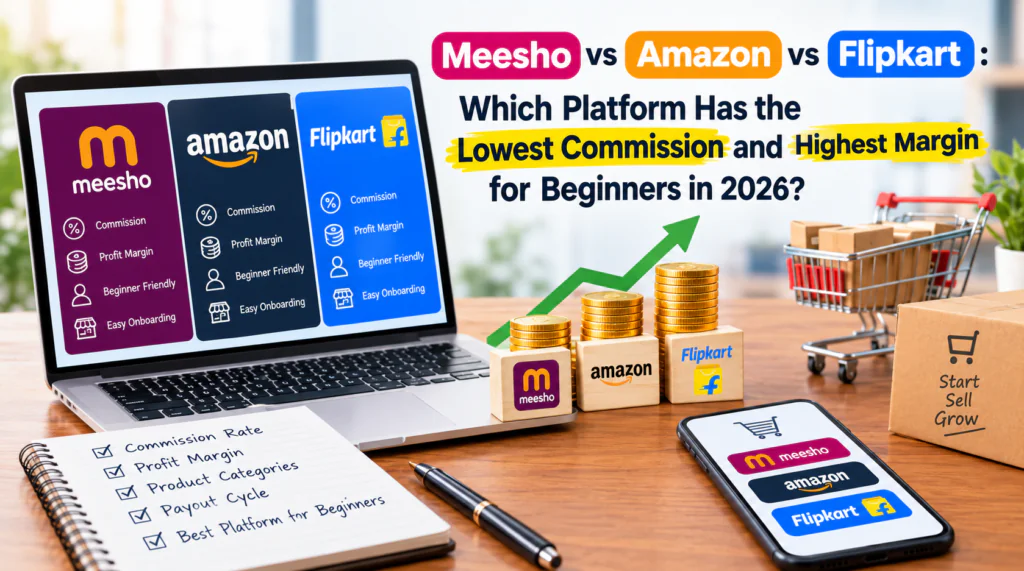
Starting an online selling business in India is one of the most profitable ventures today. However, for a new seller with a limited budget, choosing the right e-commerce platform can make or break their business.
The most common question Indian sellers ask is: “Which platform offers the lowest seller commission and the highest profit margins—Meesho, Amazon, or Flipkart?”
While Meesho is famous for its 0% referral commission model, platforms like Amazon and Flipkart offer massive buyer trust, superior logistics networks, and higher average order values (AOV).
In this comprehensive guide, we compare Meesho vs Amazon vs Flipkart across commission fees, shipping charges, hidden costs, profit margins, and return penalties to help you decide the best platform for your business in 2026.
Quick Answer
Which e-commerce platform gives the highest profit margin for beginners in India?
Meesho provides the highest direct profit margin for low-ticket, unbranded products (under ₹500) due to its zero-commission policy. However, Amazon and Flipkart offer higher overall profit potential for branded, medium-to-high ticket items (above ₹500) due to higher customer retention, lower return rates, and better order values.
1. Commission Structure Breakdown
Every e-commerce platform charges sellers fees to cover platform maintenance, payment gateway processing, and customer support. Here is how they compare:
| Feature / Fee | Meesho | Amazon India | Flipkart |
| Referral / Commission Fee | 0% across most categories | 2% to 25% (category dependent) | 3% to 22% (category dependent) |
| Closing / Fixed Fee | ₹0 | ₹5 to ₹60 per item (based on price slab) | ₹5 to ₹50 per item (based on price slab) |
| Payment Gateway Fee | 0% | Included in Referral/Closing Fee | Included in Referral/Closing Fee |
| Ideal Price Range | ₹100 – ₹500 | ₹400 – ₹5,000+ | ₹300 – ₹3,000+ |
Key Takeaway for Sellers:
- Meesho wins on upfront commissions. You do not pay any percentage of your sales price to Meesho.
- Amazon & Flipkart charge category-specific commissions along with fixed closing fees, which directly impact your gross margins on low-cost items.
2. Shipping & Logistics Costs Compared
Commission is only one part of the equation. Shipping charges can quickly consume your profit margin if you do not price your products correctly.
Meesho Logistics
- Meesho operates a national shipping network powered by third-party logistics (3PL) partners like Delhivery, Shadowfax, and XpressBees.
- Shipping fees depend on the weight and tier (Local, Regional, National).
- Advantage: Meesho often subsidizes shipping costs on specific promotions, keeping landing costs lower for price-sensitive buyers.
Amazon Logistics (Easy Ship & FBA)
- Amazon offers Easy Ship (pickup from seller) and FBA (Fulfillment by Amazon).
- FBA charges storage fees, removal fees, and pick-and-pack fees, but gives products the coveted Prime Badge.
- Advantage: Higher delivery reliability and faster transit times, which significantly lowers buyer cancellations.
Flipkart Logistics (FBF & Self-Ship)
- Flipkart uses its in-house logistics network (Ekart).
- Offers FBF (Fulfillment by Flipkart) similar to Amazon FBA.
- Advantage: Unmatched delivery reach in Tier-2, Tier-3, and Tier-4 Indian cities.
3. The Hidden Margin Killers: Customer Returns (RTO & DTO)
Return Rates are the biggest reason new sellers lose money on e-commerce platforms in India. Returns are divided into two categories:
- RTO (Return to Origin): Orders that could not be delivered to the customer (Courier Failure / Customer Refusal).
- DTO (Door-Step Return / Customer Return): Orders delivered, opened, and returned by the customer.
Total Profit Margin = (Selling Price) - (Product Cost + Commission + Fixed Fees + Shipping + Return Loss Overhead)
How Each Platform Handles Returns:
- Meesho: Customer return rates in budget fashion and unbranded categories can range from 20% to 35%. Meesho charges sellers return shipping fees on customer-initiated returns unless the item is defective or damaged. If you want to avoid common mistakes that lead to high return rates on Meesho, read our detailed guide on the top mistakes new Meesho sellers make.
- Amazon: Lower average return rates (8% to 15% for non-clothing items). Amazon customer verification is stricter, resulting in fewer fake RTOs.
- Flipkart: Return rates average around 15% to 25%, especially in apparel and footwear. Flipkart imposes strict return policies, but return shipping fees apply to sellers.
4. Profit Margin Analysis: Real Scenario Example
Let’s compare selling a Cotton T-Shirt across all three platforms:
- Product Sourcing Cost: ₹150
- Target Selling Price: ₹499
- Product Weight: Under 500g (National Shipping)
| Cost Breakdown | Meesho | Amazon India | Flipkart |
| Selling Price | ₹499 | ₹499 | ₹499 |
| Sourcing Cost | ₹150 | ₹150 | ₹150 |
| Referral Commission | ₹0 | ₹65 (13%) | ₹55 (11%) |
| Closing Fee | ₹0 | ₹25 | ₹20 |
| Shipping Charge (Approx.) | ₹75 | ₹85 | ₹80 |
| GST / Taxes (Net) | ₹15 | ₹20 | ₹18 |
| Estimated Net Margin | ₹259 (51.9%) | ₹154 (30.8%) | ₹176 (35.2%) |
Analysis: On paper, Meesho generates a significantly higher net margin per order (₹259 vs ₹154/₹176). However, after accounting for a 25% return rate on Meesho versus a 10% return rate on Amazon, the actual net monthly profit gap narrows down considerably.
5. Which Platform Should You Choose as a Beginner in 2026?
Choose Meesho If:
- You have low capital (under ₹20,000 to ₹50,000).
- You sell unbranded fashion, home decor, artificial jewelry, or daily utility products priced under ₹500.
- You want a simple onboarding process with zero upfront listing overhead. To get started smoothly, learn how to start selling on Meesho with low investment in 2026.
- Your goal is to generate high order volumes quickly. Once live, check out our proven steps to get your first 100 orders on Meesho.
Choose Amazon India if:
- You have a registered brand or unique products.
- You are aiming for higher order values (above ₹500) and customers who value fast Prime delivery.
- You want to leverage advanced PPC ads (Sponsored Products) to scale systematically.
Choose Flipkart if:
- You focus heavily on electronics, mobile accessories, fashion, and appliances.
- You want deep market penetration across Tier-2 and Tier-3 Indian cities.
- You want to participate in massive shopping events like the Big Billion Days.
Frequently Asked Questions
Q1. Is Meesho really zero commission for sellers?
Yes, Meesho charges 0% referral commission across most categories. Sellers only pay for government taxes (GST) and logistics/shipping fees when applicable.
Q2. Is selling on Amazon profitable for small sellers in India?
Yes, Amazon is highly profitable if your product margin is above 40–50% before platform fees, and if your selling price is above ₹499 to absorb shipping and closing charges.
Q3. Do I need a GST number to sell on Meesho, Amazon, or Flipkart?
Yes, a valid GST registration and PAN card are mandatory for selling on Amazon and Flipkart. For Meesho, enrollment under the simplified GST scheme for micro-sellers is allowed for intra-state sales in certain product categories, but a full GSTIN is recommended for nationwide reach.
Final Verdict
For a complete beginner with limited budget and unbranded products, Meesho is the most cost-effective gateway to e-commerce. It offers the lowest entry barrier and maximum upfront margins.
However, as your business grows and you build a brand, expanding to Amazon India and Flipkart is essential to capture high-value buyers, lower return rates, and achieve long-term stability.
Need expert help setting up or scaling your marketplace store? Contact Qbit ecommerce for end-to-end seller account management and sales boost services.