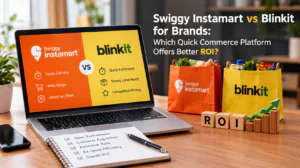

Quick commerce (Q-Commerce) has officially shifted from an emerging trend to the dominant channel for impulse, daily essentials, and direct-to-consumer (D2C) brand sales in India. With 10-to-15-minute delivery models maturing across metro cities, platforms like Blinkit, Zepto, and Swiggy Instamart are aggressively competing for market share.
For brand owners, manufacturers, and e-commerce sellers, the critical question isn’t just where consumers buy—it is which quick commerce platform offers the best seller margins, lowest operational friction, and highest payout retention.
This comprehensive 2026 seller guide breaks down payout structures, commission rates, dark store listing mechanics, and onboarding requirements for Blinkit, Zepto, and Instamart.
Quick Commerce Platform Comparison at a Glance (2026)
| Feature / Metric | Blinkit (Zomato) | Zepto | Swiggy Instamart |
|---|---|---|---|
| Average Commission Rate | 15% – 22% | 18% – 25% | 16% – 24% |
| Dark Store Footprint | Largest (Metro + Tier 1) | High Density (Top Metros) | Extensive (Multi-city Integration) |
| Payment Settlement Cycle | 7 to 14 Days | 7 to 10 Days | 7 to 14 Days |
| Inventory Model | Dark Store / Vendor Managed | Dark Store / Direct Procurement | Dark Store / Hub & Spoke |
| Onboarding Approval Time | 7 – 15 Days | 5 – 10 Days | 10 – 20 Days |
| Primary Category Strengths | Grocery, Electronics, Beauty | FMCG, Personal Care, Impulse | FMCG, Fresh Produce, Household |
1. Blinkit Seller Payout & Margin Analysis
Blinkit remains the market leader in order volume across major Tier 1 and Tier 2 cities in India. For brands with high inventory turnover, Blinkit offers unmatched velocity.
Commission Rates & Fees
-
Standard Category Commission: Range between 15% and 22%, depending on product category, ticket size, and velocity.
-
Onboarding & Slotting Fees: May require dark store listing/slotting fees for specialized or niche brand placement in high-density hubs.
-
Logistics & Warehousing: Integrated into the dark store margin structure.
Settlement & Payout Cycles
-
Payout Frequency: Weekly or bi-weekly settlement cycles following verified dark store inwarding and sales reconciliation.
-
Return/RTO Impact: Minimal RTO compared to traditional e-commerce (Amazon/Flipkart), as deliveries occur within a 2 km radius of dark stores.
Verdict for Sellers: Blinkit offers higher order volumes, which can compensate for tighter margin negotiation if your product line turns over quickly.
2. Zepto Seller Payout & Margin Analysis
Zepto operates an supply-chain model optimized for high-velocity dark store picking. It attracts D2C brands looking for high visibility among millennial and Gen Z urban demographics.
Commission Rates & Fees
-
Standard Category Commission: Typically ranges from 18% to 25%.
-
Promotional Spending: Higher push on in-app banner ads and sponsored product placements inside the app layout.
-
Margin Expectations: Zepto often negotiates higher gross margins upfront to cover rapid dark-store replenishment logistics.
Settlement & Payout Cycles
-
Payout Frequency: Faster settlement windows, often operating on a 7 to 10-day cycle.
-
Reconciliation Efficiency: Tech-forward backend portal provides real-time stock and payout visibility.
Verdict for Sellers: Zepto yields fast payout turnarounds and high brand visibility, but requires careful margin planning to offset ad placement costs.
3. Swiggy Instamart Seller Payout & Margin Analysis
Swiggy Instamart leverages the broader Swiggy ecosystem, allowing cross-promotional reach through food delivery users.
Commission Rates & Fees
-
Standard Category Commission: Ranging from 16% to 24%.
-
Storage & Handling Costs: Varies depending on whether goods are stored in regional distribution centers (RDC) or directly at dark stores (PODs).
-
Sampling & Bundle Campaigns: High potential for running co-branded sampling campaigns to drive trial.
Settlement & Payout Cycles
-
Payout Frequency: Standard 7 to 14-day payment cycles.
-
Deduction Transparency: Requires precise invoice matching to track promo discounts funded by the seller vs. funded by the platform.
Verdict for Sellers: Excellent for established brands targeting household penetration across diversified product categories.
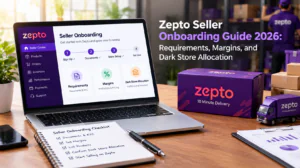
Step-by-Step: How to Get Onboarded on Blinkit, Zepto & Instamart
Getting listed on quick commerce dark stores requires specific documentation and regulatory approvals:
Required Documents:
-
GST Certificate (matching warehouse/business address)
-
FSSAI License (Mandatory for food, beverage, and nutritional products)
-
Trademark Registration Certificate (Ensures brand registry and protects listing rights)
-
Pan Card & Cancelled Cheque
-
Product Catalog with EAN/UPC Barcodes
Onboarding Steps:
-
Brand Verification & Category Manager Pitch: Submit brand deck, product USP, and margin proposal.
-
Vendor Code Creation: Complete documentation, FSSAI verification, and GST mapping.
-
PO Creation & Dark Store Mapping: Receive initial Purchase Orders (POs) for designated dark store hubs.
-
Barcode & Packaging Compliance: Ensure primary and secondary packaging meets platform scanning standards.
Frequently Asked Questions (FAQs)
Q1. Which quick commerce platform has the lowest commission for sellers in 2026?
Commission rates vary by product category rather than platform alone. Generally, Blinkit and Swiggy Instamart offer slightly more flexible commission structures (starting around 15%–16%) for high-demand FMCG products compared to Zepto, which averages between 18% and 25%.
Q2. Can small sellers and local brands sell directly on Blinkit or Zepto?
Yes, local brands can onboard if they hold valid GST and FSSAI (for food) registrations and can supply consistent inventory to assigned regional dark stores. Partnering with an e-commerce management agency speeds up regional dark store allocation and approval.
Q3. How do returns (RTO) work on Quick Commerce compared to Amazon or Flipkart?
RTO rates on quick commerce are significantly lower (<1–2%) compared to traditional e-commerce (15–30%), because deliveries occur immediately after ordering. Returns typically happen only in cases of damaged, expired, or wrong items dispatched from the dark store.
Q4. Is Trademark Registration mandatory for Quick Commerce onboarding?
While not always strictly required on day one, having a registered trademark is strongly recommended. It speeds up brand approval, secures exclusive listing rights, and prevents unauthorized sellers from hijacking your product catalog on these platforms.
Scale Your Quick Commerce Business with QBIT ECOMMERCE
Navigating vendor registration, margin negotiations, dark store PO management, and catalog compliance across Blinkit, Zepto, and Instamart can be complex.
At QBIT ECOMMERCE, we help brands:
-
Secure fast onboarding approvals across top quick commerce platforms.
-
Manage dark store inventory reconciliation and payout audits.
-
Protect brand identity with end-to-end Trademark Registration.
-
Optimize in-app advertising campaigns to drive maximum ROI.
Ready to launch your products on Quick Commerce? Contact QBIT ECOMMERCE Today for a complete onboarding and growth consultation.